
The Core Insight
The global fitness app market has exploded over the past decade. According to FitnessNav Intelligence, more than 10,000 digital fitness products now compete for attention across the $1.5 trillion global fitness economy. Yet despite the abundance of options, most users struggle with the same question:
Which fitness app actually produces measurable results?
Across published pricing, subscription terms, and what users report about each product, a pattern emerges:
Many fitness apps are sophisticated marketing platforms—but relatively simple training engines.
In other words, they excel at acquisition and retention mechanics, but their underlying workout programming algorithms often remain limited.
This is why comparisons like MadMuscles vs Fitbod, MadMuscles vs BetterMe, or MadMuscles vs Freeletics have become increasingly relevant for consumers searching for an AI-driven personal trainer experience.
At FitnessNav Intelligence, we evaluate fitness platforms using our proprietary FitnessNav VERIFY™ methodology, which analyzes products across several decision-critical dimensions:
- Algorithm Personalization
- Workout Science Credibility
- User Experience Friction
- Content Library Depth
- Subscription Transparency
- Market Sentiment Signals
Using these criteria, this report examines how MadMuscles performs against eight major competitors:
- BetterMe
- Fitbod
- Freeletics
- Muscle Booster
- Ladder
- Zing Coach
- MyFitCoach
- FitMe
The goal is not simply to crown a “winner,” but to help users understand which platform fits different training goals, budgets, and expectations.
The Rise of AI Fitness Coaching
Why Fitness Apps Are Replacing Traditional Programs
The shift toward digital fitness coaching accelerated during the pandemic, but the underlying trend began earlier: consumers increasingly prefer personalized, on-demand training experiences over static workout programs.
Several technologies now power modern fitness apps:
- Machine Learning Personalization
- AI Workout Generation
- Biofeedback Loops
- Computer Vision Movement Tracking
- Wearable Integration (Apple Watch, Garmin, Fitbit)
Apps like Fitbod and Zing Coach rely heavily on algorithmic training generation, while others like Ladder focus on coach-led programming and community accountability.
The promise is compelling: instead of following a generic PDF workout plan, users receive a dynamic training system that adapts to:
- training history
- muscle recovery
- equipment availability
- fitness goals
- biometric feedback
However, the reality is more complicated.
Many apps claim AI personalization, yet their workout systems remain closer to template-based programming engines rather than fully adaptive models.
Understanding where MadMuscles sits on this spectrum requires a closer look at how the platform actually works.
What MadMuscles Actually Does (And Why It Became Popular)
The Hypertrophy-Focused Training Model
Unlike some competitors that focus on general fitness or weight loss, MadMuscles positions itself specifically around muscle-building and body recomposition.
The platform’s marketing emphasizes hypertrophy training, a methodology rooted in sports science that aims to stimulate muscle growth through:
- Progressive Overload
- Mechanical Tension
- Metabolic Stress
- Training Volume Management
This focus resonates with a large audience segment: users who want structured strength training without hiring a personal trainer.
Typical MadMuscles programs include:
- gym-based hypertrophy workouts
- home workouts with minimal equipment
- targeted muscle group routines
- progressive weekly training plans
The onboarding process asks users for several key inputs:
- height and weight
- training experience
- available equipment
- body composition goals
- weekly training frequency
Based on these factors, the system generates a customized training schedule.
However, the real question is not whether MadMuscles can generate a plan—most apps can.
The key issue is how intelligently that plan evolves over time.
Personalization: Algorithm or Template?
One of the most common claims across AI fitness platforms is “adaptive workouts.”
In theory, this means the app dynamically adjusts training variables such as:
- exercise selection
- volume load
- rest intervals
- training frequency
- progressive overload
However, according to FitnessNav market analysis and user feedback, the reality varies widely between apps.
MadMuscles appears to use a semi-dynamic model:
- workouts are structured around preset training templates
- exercises rotate periodically
- difficulty increases across program phases
But unlike Fitbod, which integrates muscle recovery tracking, MadMuscles does not heavily rely on real-time physiological feedback such as:
- Heart Rate Variability (HRV)
- fatigue scoring
- wearable recovery metrics
This means the system functions more like a guided workout planner than a fully adaptive AI strength coach.
For many users, that distinction matters less than expected.
What they actually want is:
- clear workout structure
- simple progression
- minimal decision fatigue
MadMuscles performs relatively well in this area.
Where the platform faces stronger competition is in algorithm depth and workout adaptation, which becomes clearer when we compare it with leading apps like Fitbod.
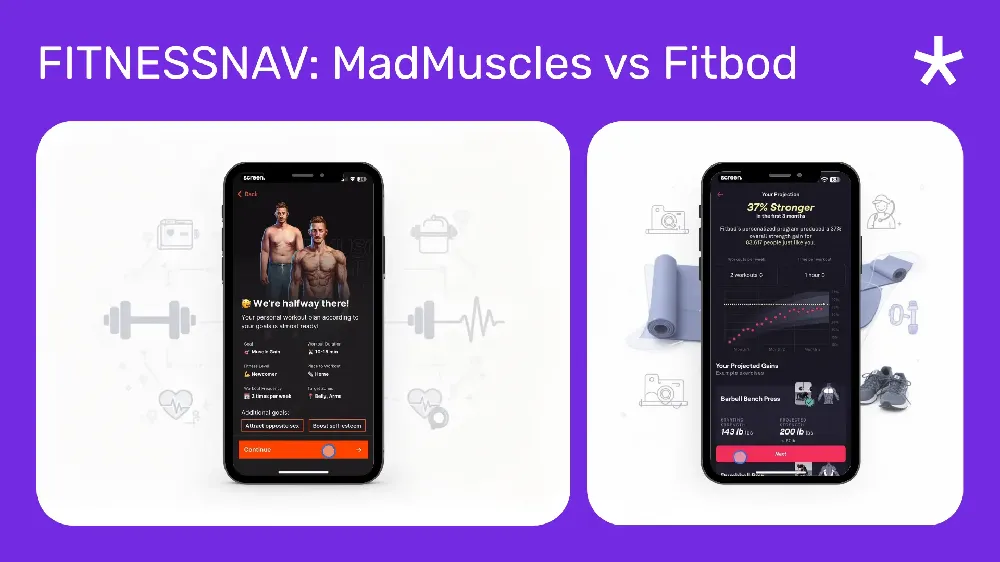
MadMuscles vs Fitbod
Algorithm-Driven Strength Training vs Structured Programs
Among all competitors, Fitbod is arguably the closest conceptual rival to MadMuscles.
Both apps focus on strength training and hypertrophy, but they approach workout programming in fundamentally different ways.
Fitbod’s Core Philosophy
Fitbod positions itself as a data-driven strength training engine.
Its algorithm analyzes:
- previously trained muscle groups
- exercise fatigue
- available equipment
- user feedback
- recovery time
Based on this data, the system automatically generates each workout session.
The platform essentially functions like a training recommendation engine, similar to how streaming services recommend movies.
Key features include:
- Gym equipment integration
- muscle recovery tracking
- automatic progressive overload
- exercise substitution
This means two users rarely receive identical workouts.
MadMuscles Training Structure
MadMuscles takes a more structured program-based approach.
Workouts follow a clear routine progression:
- push/pull splits
- upper/lower splits
- targeted muscle group days
This model mirrors traditional bodybuilding programming, which many gym users find intuitive.
However, the system does not adjust exercises as aggressively based on fatigue or training history.
Instead, progression occurs through:
- increasing difficulty
- adding volume
- changing exercise variations
For beginners and intermediate lifters, this approach is often sufficient.
Advanced users, however, may prefer Fitbod’s adaptive training engine.
FitnessNav Comparison Snapshot
| Feature | MadMuscles | Fitbod |
| Training Focus | Hypertrophy Programs | Adaptive Strength Training |
| Personalization | Moderate | High |
| Recovery Tracking | Limited | Advanced |
| Equipment Integration | Basic | Extensive |
| Ideal User | Beginners to Intermediate | Data-driven lifters |
FitnessNav Insight
From a strategic standpoint, the difference between the two apps reflects a broader divide in the fitness tech industry:
Program-Based Apps vs Algorithm-Based Apps.
MadMuscles prioritizes clarity and simplicity, while Fitbod emphasizes algorithmic optimization.
For users who enjoy structured programs similar to those used by bodybuilding coaches, MadMuscles can feel more intuitive.
For those who prefer data-driven workout generation, Fitbod likely offers the more advanced system.
MadMuscles vs BetterMe
Muscle-Building Programs vs Lifestyle Coaching Platforms
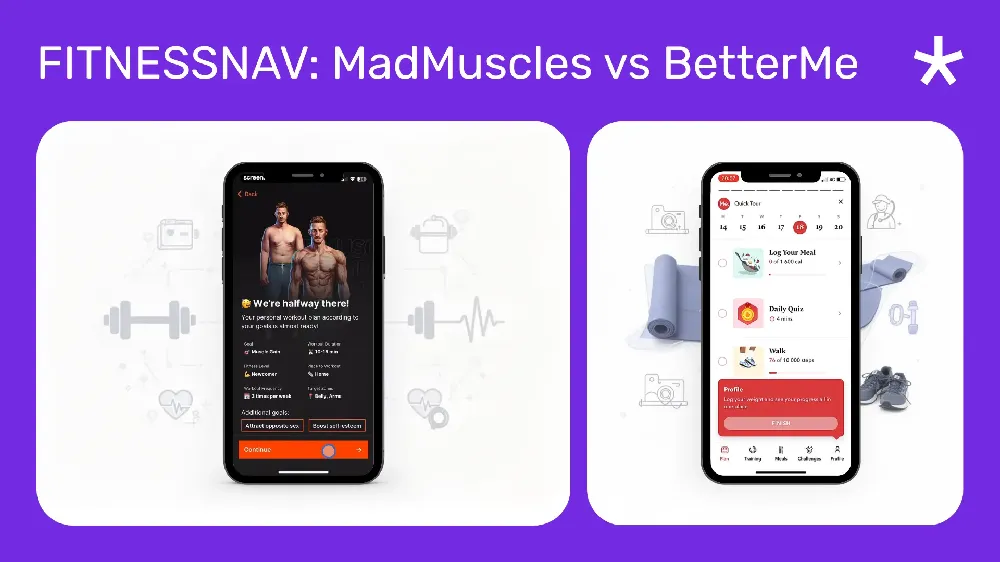
At first glance, MadMuscles and BetterMe appear to occupy similar positions in the fitness app ecosystem. Both apps promise personalized training, structured programs, and measurable fitness outcomes.
However, their underlying philosophies are fundamentally different.
MadMuscles focuses heavily on hypertrophy-based strength training, while BetterMe operates more as a holistic lifestyle coaching platform that blends workouts, nutrition plans, and behavioral psychology.
Understanding this difference is critical when evaluating which platform actually aligns with a user’s goals.
For individuals primarily seeking muscle growth and structured resistance training, MadMuscles generally offers more specialized programming. But for users focused on weight loss, habit building, and daily health routines, BetterMe may provide a broader ecosystem.
BetterMe’s Behavioral Fitness Model
BetterMe became one of the fastest-growing fitness apps globally by focusing on behavioral transformation rather than pure workout performance.
Instead of emphasizing advanced training concepts such as progressive overload or training periodization, the platform prioritizes habit formation and long-term adherence.
Key components of the BetterMe experience include:
- guided workout plans
- personalized nutrition recommendations
- meditation and mindfulness features
- daily health challenges
- habit-tracking systems
In many ways, BetterMe operates closer to a digital wellness coach than a traditional strength-training platform.
This design reflects a broader trend in the digital fitness economy: many consumers struggle more with consistency than with training knowledge.
By embedding gamification systems, reminders, and motivational prompts, BetterMe attempts to solve the psychological barriers that prevent users from maintaining exercise routines.
However, this approach comes with tradeoffs.
Because the platform targets a wide range of users—from beginners to casual exercisers—its strength-training depth is relatively limited compared to specialized apps like MadMuscles.
MadMuscles’ Strength Training Advantage
MadMuscles distinguishes itself by focusing specifically on muscle hypertrophy and strength progression.
Programs typically emphasize:
- structured resistance workouts
- progressive overload progression
- muscle group splits
- hypertrophy-focused volume
These elements align more closely with evidence-based strength training principles commonly used by personal trainers and bodybuilding coaches.
For example, hypertrophy training often requires careful manipulation of variables such as:
- volume load
- training frequency
- time under tension (TUT)
- rest intervals
MadMuscles attempts to structure these variables within its training programs, giving users a clearer path toward muscle development rather than general fitness maintenance.
That said, the app still operates primarily as a guided training planner, rather than a highly adaptive training algorithm.
Compared with platforms like Fitbod, its workout adjustments rely more on predefined program structures than on continuous data feedback.
Nutrition and Lifestyle Integration
Where BetterMe clearly outperforms MadMuscles is nutrition and lifestyle integration.
The platform includes extensive tools for:
- calorie tracking
- macro-nutrient optimization
- meal planning
- behavioral habit reinforcement
For users pursuing weight loss or body recomposition, these elements often play a larger role than workout programming alone.
MadMuscles does include some nutrition guidance, but it remains secondary to its workout programming system.
FitnessNav market data suggests that this difference influences user retention patterns.
Apps focused on lifestyle ecosystems—like BetterMe—often generate higher subscription retention rates, because users interact with the platform multiple times per day.
Workout-only platforms tend to experience higher churn rates once users complete a training program.
FitnessNav Comparison Snapshot
| Feature | MadMuscles | BetterMe |
| Primary Goal | Muscle Growth | Weight Loss & Lifestyle |
| Training Depth | Moderate–High | Low–Moderate |
| Nutrition Integration | Basic | Extensive |
| Behavioral Psychology | Limited | Strong |
| Ideal User | Strength training beginners | Lifestyle-focused users |
FitnessNav Insight
From a market strategy perspective, the comparison between MadMuscles and BetterMe reflects two different segments of the digital fitness economy:
performance-oriented training apps vs lifestyle wellness ecosystems.
MadMuscles aims to replicate the structure of a gym-based training program, while BetterMe focuses on long-term behavior change.
For users seeking serious strength training, MadMuscles typically provides the more relevant experience.
But for those prioritizing habit formation, weight management, and daily health routines, BetterMe may deliver greater value.
MadMuscles vs Freeletics
Bodyweight Training Philosophy vs Gym-Based Strength Training
Another frequently searched comparison in the fitness app space is MadMuscles vs Freeletics.
These platforms represent two distinct schools of training philosophy.
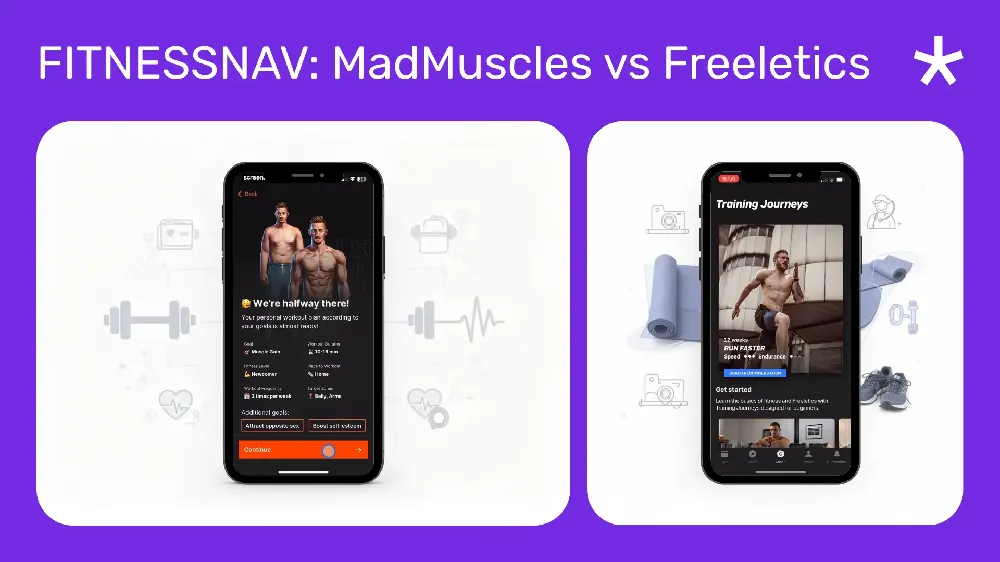
MadMuscles centers on hypertrophy-driven strength training, while Freeletics built its reputation around high-intensity bodyweight workouts that can be performed without gym equipment.
This difference significantly affects the type of user each platform attracts.
The Freeletics Training System
Founded in Germany, Freeletics became one of Europe’s most recognized digital fitness brands by promoting intense bodyweight training programs designed to build strength, endurance, and athletic performance.
Its workouts often incorporate:
- high-intensity interval training (HIIT)
- plyometric movements
- bodyweight strength exercises
- running-based conditioning
Typical exercises include:
- burpees
- pull-ups
- push-ups
- squats
- sprints
These sessions are usually designed to maximize metabolic stress and cardiovascular conditioning, making them highly effective for improving overall fitness.
Freeletics also integrates audio coaching, which guides users through workouts without requiring them to constantly look at their phone.
This feature reduces user experience friction and improves workout flow.
Muscle Hypertrophy vs Functional Fitness
While Freeletics workouts can build strength, they are not specifically optimized for muscle hypertrophy.
Muscle growth typically requires controlled resistance training with sufficient mechanical tension and progressive overload.
Bodyweight workouts can provide these stimuli to some extent, particularly for beginners. However, they often become less effective for advanced muscle growth once users adapt to the resistance level.
MadMuscles addresses this limitation by emphasizing gym-based training environments, where users can progressively increase resistance through:
- dumbbells
- barbells
- resistance machines
- weighted exercises
This allows the training system to support long-term muscle development progression.
For users with access to a gym, this model generally offers greater potential for hypertrophy compared with bodyweight-only training.
Personalization and AI Coaching
Both MadMuscles and Freeletics claim to offer personalized training plans, but their systems differ in structure.
Freeletics uses a training AI coach that adjusts workout difficulty based on user feedback and performance metrics.
After each workout, users report perceived exertion levels and completion status. The algorithm then adapts future sessions accordingly.
This feedback loop creates a simple biofeedback adaptation model, though it still relies heavily on predefined workout templates.
MadMuscles, by contrast, focuses more on structured program progression.
Rather than adjusting workouts daily, it guides users through multi-week training blocks that gradually increase intensity.
Both approaches have advantages.
Freeletics provides greater day-to-day variation, while MadMuscles offers more predictable long-term progression.
FitnessNav Comparison Snapshot
| Feature | MadMuscles | Freeletics |
| Training Type | Gym-based hypertrophy | Bodyweight HIIT |
| Equipment Required | Moderate | Minimal |
| Personalization | Program-based | Feedback-based |
| Conditioning Focus | Moderate | High |
| Ideal User | Muscle-building beginners | Home workout enthusiasts |
FitnessNav Insight
The comparison between MadMuscles and Freeletics highlights an important reality in the digital fitness market:
Different apps optimize for different training outcomes.
Freeletics excels at delivering high-intensity workouts that require little equipment, making it attractive to users training at home or while traveling.
MadMuscles, on the other hand, is better suited for individuals seeking structured resistance training programs designed to support muscle growth.
The right choice ultimately depends on whether the user prioritizes strength development or functional conditioning.
MadMuscles vs Muscle Booster
Two Apps With Surprisingly Similar Origins
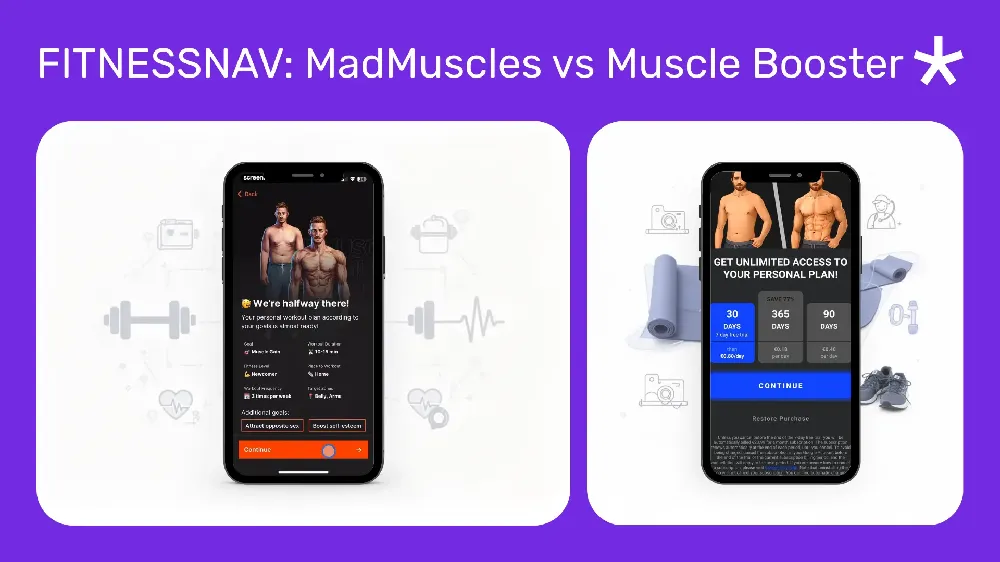
Among all the competitors in this comparison, Muscle Booster is arguably the most similar to MadMuscles—not just in training philosophy but also in product structure and marketing strategy.
Both platforms target users who want muscle-building workout programs without hiring a personal trainer, and both rely heavily on onboarding questionnaires to generate customized workout plans.
The typical onboarding flow includes:
- body type analysis
- fitness goals
- experience level
- available equipment
- weekly training schedule
Once this information is collected, the system generates a structured training program.
From the user’s perspective, the experience initially feels similar across both apps.
However, when examined more closely through the FitnessNav VERIFY™ methodology, some important differences emerge.
Template-Based Programming Systems
Unlike highly adaptive platforms such as Fitbod, both MadMuscles and Muscle Booster rely primarily on template-based workout programming.
This means workouts are generated from a library of predefined routines rather than continuously recalculated by a machine-learning model.
These templates are often organized around standard training structures such as:
- push/pull splits
- upper/lower body routines
- full-body beginner programs
- hypertrophy-focused weekly cycles
Template-based programming is not inherently inferior. In fact, many professional coaches use similar frameworks when designing training plans.
However, it limits the platform’s ability to dynamically adjust variables such as:
- muscle fatigue
- recovery time
- progressive overload progression
- training volume optimization
In practice, this means users often experience less variability between sessions compared to fully adaptive AI training engines.
For beginners, this structure can actually be beneficial because it reduces decision fatigue.
For more advanced lifters, the limitations may become noticeable after several training cycles.
Marketing Strategy vs Training Depth
Where Muscle Booster and MadMuscles diverge most strongly is in their content depth and training guidance.
MadMuscles tends to present its programs as longer-term muscle development systems, with clear progression phases and structured training blocks.
Muscle Booster, by contrast, often focuses more heavily on short-term transformation narratives, emphasizing quick visual results in its marketing campaigns.
This difference affects the way users perceive each platform.
Apps that promise rapid transformations frequently attract large numbers of new users but also face higher churn rates when expectations are not immediately met.
FitnessNav market sentiment analysis indicates that user retention tends to correlate strongly with realistic training timelines.
Muscle hypertrophy, after all, is a slow physiological process involving:
- neuromuscular adaptation
- progressive resistance exposure
- adequate recovery cycles
Apps that frame muscle building as a gradual process often build more sustainable user expectations.
FitnessNav Comparison Snapshot
| Feature | MadMuscles | Muscle Booster |
| Training Model | Structured hypertrophy programs | Template-based routines |
| Personalization | Moderate | Moderate |
| Workout Library | Medium | Medium |
| Marketing Focus | Muscle development | Fast transformation |
| Ideal User | Beginner lifters | Casual fitness users |
FitnessNav Insight
From a market perspective, MadMuscles and Muscle Booster illustrate an interesting pattern within the digital fitness economy.
Many apps compete within the same functional category, but differentiate themselves primarily through branding, marketing tone, and onboarding experience rather than radically different training algorithms.
For consumers, this means the perceived differences between apps may sometimes be larger than the underlying technological differences.
MadMuscles generally stands out slightly in this comparison because its training structure appears more closely aligned with traditional hypertrophy programming principles.
MadMuscles vs Ladder
AI Training Systems vs Coach-Led Fitness Platforms
The comparison between MadMuscles and Ladder reveals one of the most important strategic divides in the modern fitness industry:
algorithm-driven coaching vs human-led coaching ecosystems.
MadMuscles represents the AI program generation model, where software builds and manages training routines.
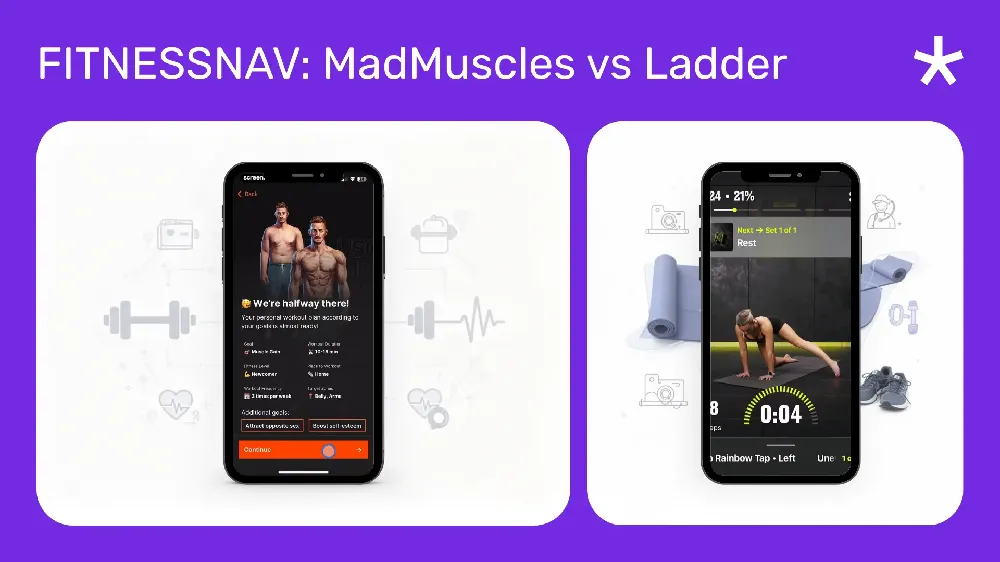
Ladder, on the other hand, centers its entire platform around professional coaches who lead structured programs.
This difference fundamentally changes how users experience each platform.
The Ladder Coaching Ecosystem
Ladder was designed to replicate the structure of a team-based training environment.
Instead of interacting primarily with an algorithm, users join programs led by professional trainers and athletes.
These programs typically include:
- structured weekly workouts
- instructional video sessions
- coach-led guidance
- community interaction
Users essentially become part of a digital training team, which introduces a powerful psychological component: accountability.
FitnessNav behavioral data suggests that community-based platforms often achieve higher engagement because users feel socially connected to the program.
Training alongside others—even virtually—can significantly increase motivation.
AI Coaching vs Human Coaching
While Ladder provides strong human guidance, it sacrifices some of the flexibility offered by AI-driven systems.
MadMuscles programs can be generated instantly and customized according to:
- user schedule
- available equipment
- training goals
This scalability allows AI-driven apps to serve millions of users simultaneously.
Human-led platforms inevitably face capacity limitations.
A single coach cannot realistically personalize workouts for tens of thousands of participants.
As a result, most Ladder programs still rely on standardized weekly training structures, even though they are presented through a coach-led format.
In practice, the difference between these models often comes down to user preference rather than pure technological superiority.
Some users prefer the structure and accountability of a human coach, while others prefer the autonomy of AI-generated programs.
FitnessNav Comparison Snapshot
| Feature | MadMuscles | Ladder |
| Coaching Model | AI-generated programs | Human coaches |
| Community Features | Minimal | Strong |
| Personalization | Moderate | Moderate |
| Social Motivation | Low | High |
| Ideal User | Independent gym users | Community-oriented trainees |
FitnessNav Insight
Ladder demonstrates that community dynamics remain one of the most powerful retention mechanisms in digital fitness.
Even the most sophisticated training algorithm cannot fully replace the motivational impact of a real coach and a supportive community.
However, AI-driven platforms like MadMuscles retain a key advantage in scalability and instant personalization.
As AI fitness technology evolves, the most successful platforms may eventually combine these two models—algorithmic training with human coaching overlays.
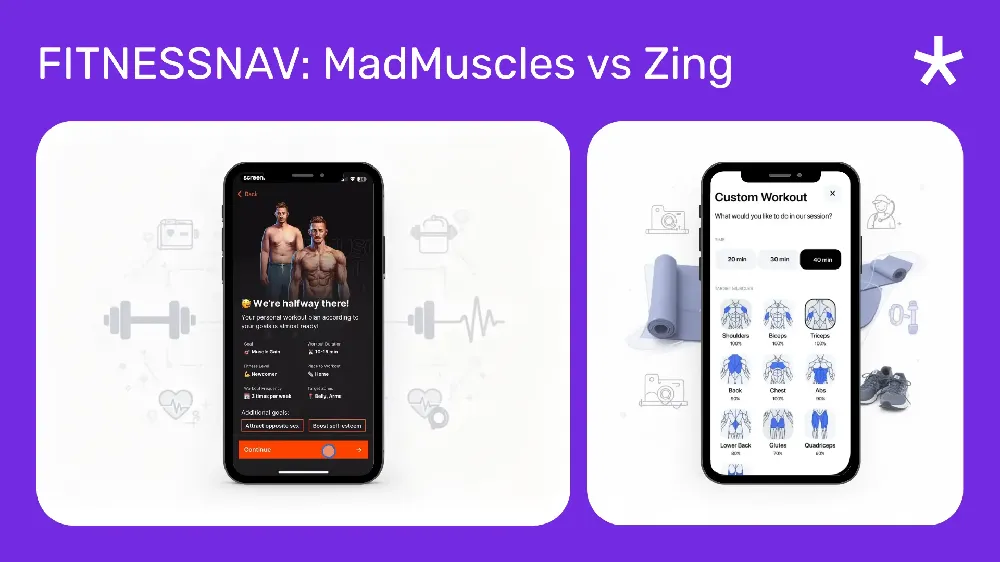
MadMuscles vs Zing
The Rise of Computer Vision Fitness Coaching
One of the most technologically ambitious competitors in this comparison is Zing Coach, an AI fitness platform that integrates computer vision technology to analyze user movements in real time.
Unlike traditional workout apps that simply display exercise videos, Zing attempts to act as a real-time digital trainer.
Using the smartphone camera, the platform analyzes body movement patterns and provides feedback on:
- exercise form
- posture alignment
- repetition quality
- movement range
This technology relies on computer vision algorithms similar to those used in motion tracking systems.
In theory, such systems could dramatically improve the accuracy of digital coaching.
However, the practical effectiveness of computer vision fitness coaching remains an evolving field.
Real-Time Feedback vs Program Structure
Where Zing excels is in movement analysis.
Real-time form correction can help users avoid common exercise mistakes such as:
- improper squat depth
- rounded back during deadlifts
- incorrect shoulder positioning
These errors can reduce workout effectiveness or increase injury risk.
MadMuscles does not currently provide this level of movement tracking.
Instead, it relies on instructional videos and written guidance to demonstrate proper technique.
While this approach is standard across most fitness apps, it places more responsibility on users to self-monitor their form.
The Current Limits of Computer Vision Coaching
Despite its potential, computer vision fitness technology still faces several limitations.
Environmental factors such as lighting, camera positioning, and room space can affect tracking accuracy.
Additionally, analyzing complex compound movements in real time remains technically challenging.
As a result, many early implementations of computer vision coaching focus primarily on basic movement detection rather than full biomechanical analysis.
Nevertheless, the technology represents one of the most promising directions for future AI fitness platforms.
If perfected, it could significantly narrow the gap between digital training apps and in-person coaching.
FitnessNav Comparison Snapshot
| Feature | MadMuscles | Zing |
| Training Model | Program-based | AI + Computer Vision |
| Form Feedback | Video guidance | Real-time tracking |
| Personalization | Moderate | Emerging |
| Technology Complexity | Medium | High |
| Ideal User | Gym-focused trainees | Tech-driven home users |
FitnessNav Insight
Zing illustrates how rapidly the AI fitness landscape is evolving.
While MadMuscles focuses on structured hypertrophy programming, Zing represents the next generation of sensor-driven coaching systems.
The long-term winner in this space will likely be the platform that successfully integrates:
- adaptive workout algorithms
- real-time movement analysis
- behavioral motivation systems
Most current apps still excel in only one or two of these areas.
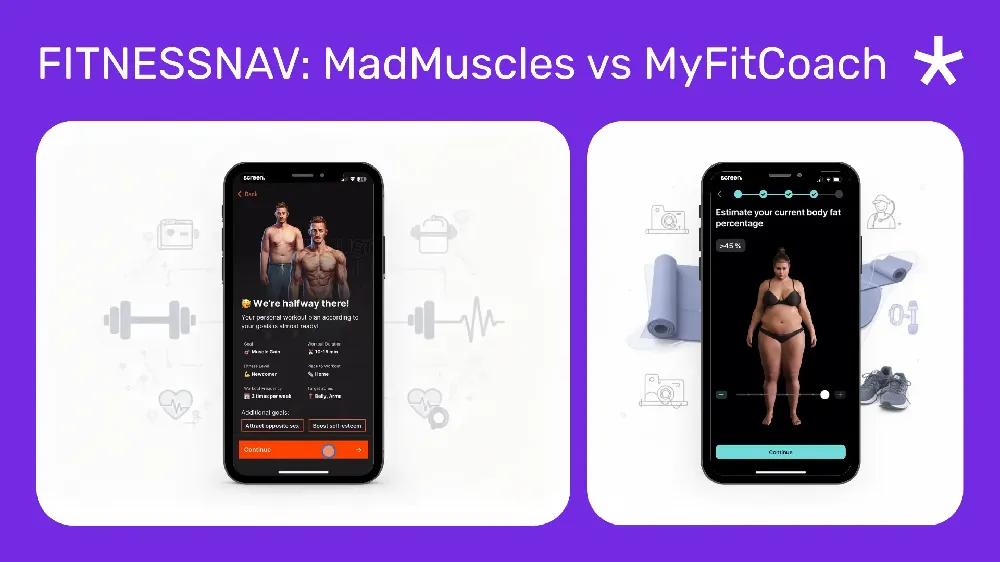
MadMuscles vs MyFitCoach
European Engineering vs Global Fitness App Design
Compared with many mainstream fitness apps, MyFitCoach represents a slightly different design philosophy rooted in European sports science traditions.
While MadMuscles positions itself as a hypertrophy-focused workout generator, MyFitCoach attempts to deliver a more scientifically structured training experience inspired by strength training research.
Programs typically incorporate concepts such as:
- training periodization
- progressive overload cycles
- volume management
- neuromuscular adaptation
These concepts are widely used in professional strength training environments and are often associated with long-term athletic development rather than short-term transformation goals.
Structured Periodization vs Program Simplicity
MadMuscles programs generally follow clear workout splits designed for accessibility:
- upper/lower splits
- push/pull training
- targeted muscle groups
These structures work well for beginners and intermediate users because they are easy to follow and require minimal planning.
MyFitCoach, however, sometimes introduces more complex training cycles, where intensity and volume fluctuate across multiple weeks.
This approach reflects traditional periodized training models used in strength sports.
In theory, periodization allows athletes to optimize performance by balancing:
- workload intensity
- recovery time
- muscular adaptation phases
For everyday users, however, such complexity can occasionally become a barrier to consistency.
FitnessNav market analysis suggests that overly complicated training systems sometimes lead to higher drop-off rates among casual users, who simply want straightforward workouts without analyzing training variables.
Algorithm Depth and Personalization
In terms of personalization, both MadMuscles and MyFitCoach occupy the middle ground between fully adaptive AI coaching and static workout templates.
Both platforms generate programs based on onboarding inputs such as:
- training experience
- body composition goals
- equipment access
- workout frequency
However, neither system yet reaches the level of real-time adaptive training algorithms found in the most advanced AI fitness platforms.
Instead, personalization occurs primarily during the initial program generation phase, with gradual adjustments as users progress.
This approach remains common across many digital fitness products because it balances algorithm complexity with product stability.
FitnessNav Comparison Snapshot
| Feature | MadMuscles | MyFitCoach |
| Training Focus | Hypertrophy programs | Periodized training |
| Algorithm Depth | Moderate | Moderate |
| Complexity | Beginner-friendly | Slightly technical |
| Personalization | Program-based | Program-based |
| Ideal User | Gym beginners | Data-oriented trainees |
FitnessNav Insight
The comparison between MadMuscles and MyFitCoach highlights a broader tension in the fitness app industry:
simplicity vs scientific sophistication.
While sports science research can improve training outcomes, most consumers ultimately prioritize clarity, convenience, and consistency.
Apps that strike the right balance between scientific credibility and usability tend to perform best in long-term user retention.
MadMuscles currently leans more strongly toward accessibility, which may explain its popularity among first-time gym users.
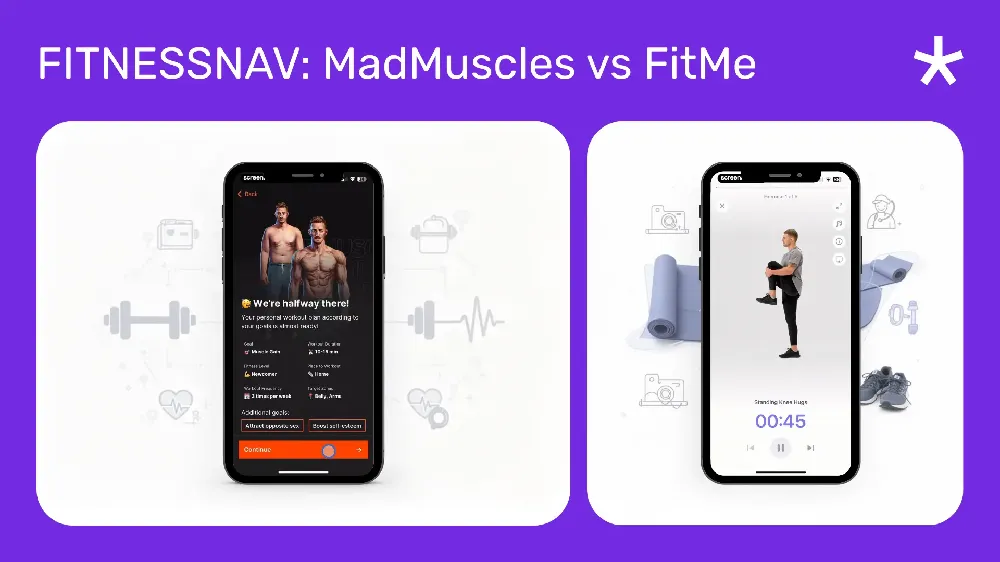
MadMuscles vs FitMe
Minimalist Training Apps vs Structured Programs
Compared with many of the apps discussed in this report, FitMe represents a more minimalist approach to digital fitness.
Instead of positioning itself as a comprehensive AI coaching system, FitMe focuses on delivering simple workout routines and basic fitness tracking tools.
This streamlined design appeals to users who want quick access to workouts without navigating complex program structures.
However, it also limits the platform’s ability to deliver long-term progression systems.
Content Library and Workout Variety
One area where MadMuscles maintains a clear advantage is content library depth.
Effective fitness platforms require extensive exercise databases, including:
- instructional videos
- alternative exercise variations
- muscle-specific training guides
MadMuscles provides a moderately large exercise library designed to support structured hypertrophy programs.
FitMe’s content library, by comparison, tends to be smaller and more generalized.
While this simplicity can make the app easier to navigate, it may also reduce the ability to support long-term training progression and workout variation.
For beginners experimenting with home workouts, FitMe may still provide a convenient entry point.
However, users pursuing sustained muscle development typically require more comprehensive training structures.
FitnessNav Comparison Snapshot
| Feature | MadMuscles | FitMe |
| Workout Depth | Moderate–High | Basic |
| Exercise Library | Medium | Small |
| Personalization | Moderate | Low |
| Program Structure | Structured | Minimal |
| Ideal User | Structured training beginners | Casual exercisers |
Subscription Pricing and Transparency
The Hidden Economics of Fitness Apps
While workout programming often receives the most attention in fitness app comparisons, subscription models frequently play an equally important role in the user experience.
Many digital fitness platforms rely on freemium funnels, where users download the app for free but must subscribe to unlock personalized training plans.
Typical pricing structures across the industry include:
- monthly subscriptions
- annual plans
- trial periods
- discounted promotional offers
- However, subscription transparency varies widely between platforms.
Some apps clearly communicate pricing during onboarding, while others introduce paywalls only after users complete lengthy questionnaires.
Refund Policies and User Trust
Another recurring issue in the digital fitness market involves refund policies and billing clarity.
Because many apps automatically renew subscriptions, users sometimes report difficulties canceling plans or obtaining refunds.
FitnessNav market sentiment analysis suggests that subscription transparency strongly influences long-term brand trust.
Apps that clearly communicate:
- billing schedules
- cancellation processes
- refund eligibility
tend to maintain stronger reputational scores across review platforms such as Apple App Store and Google Play.
MadMuscles falls roughly within the industry average in this regard.
Its subscription model typically includes:
- discounted trial offers
- multi-month plan options
- auto-renewal billing
Users considering any fitness app subscription should always review the terms of service carefully before committing.
What Real Users Say About MadMuscles
While product features and training algorithms are important, real user experiences often reveal details that marketing pages rarely mention. Across app stores and online communities, discussions about MadMuscles frequently focus on two areas: the effectiveness of workout programs and the clarity of subscription billing.
Many users report that the training plans themselves are relatively straightforward and easy to follow, especially for beginners who want structured hypertrophy routines. However, some community discussions also highlight confusion around trial conversions and recurring billing models—an issue that is not unique to MadMuscles but appears across many subscription-based fitness apps.
For example, several users have shared their personal experiences in a community discussion about MadMuscles subscription practices, describing situations where they did not initially realize how the trial period converted into a recurring plan. While individual experiences vary, these discussions illustrate why subscription transparency has become a key evaluation factor in the digital fitness industry.
From a market intelligence perspective, this feedback highlights an important trend: modern fitness apps must balance growth-oriented subscription models with clear communication about billing terms. Platforms that prioritize transparency tend to build stronger long-term trust with users.
Is MadMuscles Worth It in 2026?
Whether MadMuscles is worth the investment largely depends on the user’s fitness goals and expectations. For beginners looking for structured strength training programs, the platform offers a relatively simple way to follow hypertrophy-focused routines without hiring a personal trainer.
The onboarding process generates personalized workout plans based on factors such as fitness experience, equipment availability, and training frequency. This approach can help reduce decision fatigue for users who are new to resistance training and unsure how to structure their workouts.
However, compared with more advanced fitness apps such as Fitbod, MadMuscles provides less dynamic workout adaptation. The system relies more heavily on structured program templates rather than real-time algorithm adjustments based on recovery data or workout history.
For users who value clear workout structure and simplicity, MadMuscles can be a practical option. Those seeking deeper AI-driven training optimization may prefer more adaptive platforms.
From a broader market perspective, the app sits in the middle of the fitness app landscape: more specialized than general wellness platforms like BetterMe, but less technologically advanced than emerging AI coaching systems.
Who Should Use MadMuscles?
MadMuscles is best suited for users who want a straightforward approach to strength training without navigating overly complex training systems.
Based on the FitnessNav market analysis, the platform tends to appeal to three primary user groups:
1. Beginner gym users
Individuals who recently started strength training often benefit from structured workout splits and guided routines. MadMuscles provides clear weekly programs that make it easier to stay consistent in the gym.
2. Users focused on muscle-building goals
Unlike many fitness apps that emphasize weight loss or general wellness, MadMuscles centers its programming around hypertrophy-based resistance training, which makes it attractive to users looking to increase muscle mass.
3. People who prefer guided routines over algorithm-generated workouts
Some users find fully adaptive AI workout systems unpredictable. MadMuscles instead offers a more traditional training structure that resembles programs created by human trainers.
However, the app may be less suitable for advanced athletes who require highly customized training variables such as recovery-based volume adjustments or wearable-integrated performance tracking.
Best Alternatives to MadMuscles
Although MadMuscles provides structured strength training programs, several other fitness apps offer different approaches that may better suit certain users.
Some of the most notable alternatives include:
Fitbod
Fitbod is widely considered one of the most advanced AI-driven workout apps. Its algorithm dynamically adjusts workouts based on previous sessions, muscle recovery, and available gym equipment. Users who prefer data-driven training optimization often gravitate toward Fitbod.
BetterMe
BetterMe focuses more heavily on lifestyle transformation. The platform combines workouts, nutrition planning, and behavioral psychology tools to help users build sustainable health habits. It is often a better choice for individuals focused on weight loss rather than muscle hypertrophy.
Freeletics
Freeletics specializes in bodyweight and high-intensity training programs, making it particularly attractive for users who prefer home workouts without gym equipment.
Ladder
Ladder offers a different experience by emphasizing coach-led programs and community-driven training environments, which can improve motivation and accountability.
Each of these platforms reflects a different philosophy within the digital fitness industry, ranging from AI-generated workout systems to human-led coaching ecosystems.
Choosing the right app ultimately depends on whether the user prioritizes algorithm personalization, structured training programs, lifestyle support, or community motivation.
You can also explore our full fitness app comparison guide for a deeper analysis of the leading digital training platforms.
FitnessNav Insight: User feedback across multiple platforms suggests that transparency in pricing and subscription policies is becoming one of the most important decision factors when choosing a fitness app.
FitnessNav VERIFY™ Final Evaluation
Using the FitnessNav VERIFY™ methodology, we evaluated each platform across five core dimensions:
- Algorithm Personalization
- Training Science Credibility
- User Experience Design
- Content Library Depth
- Subscription Transparency
Below is the final strategic comparison.
FitnessNav Strategic Comparison Table
| App | Personalization | Training Science | UX Design | Content Depth | FitnessNav Score |
| MadMuscles | Moderate | Moderate | Good | Moderate | 7.5 / 10 |
| Fitbod | High | High | Good | High | 8.5 / 10 |
| BetterMe | Moderate | Moderate | Excellent | High | 8.0 / 10 |
| Freeletics | Moderate | High | Good | High | 8.0 / 10 |
| Muscle Booster | Moderate | Moderate | Moderate | Moderate | 7.0 / 10 |
| Ladder | Moderate | High | Good | High | 8.3 / 10 |
| Zing | High | Emerging | Good | Moderate | 8.1 / 10 |
| MyFitCoach | Moderate | High | Moderate | Moderate | 7.8 / 10 |
| FitMe | Low | Basic | Good | Basic | 6.5 / 10 |
Which Fitness App Is Best for Different Users?
Because fitness goals vary widely, the “best” app depends heavily on individual priorities.
Best for AI-Driven Strength Training
Fitbod
Best suited for users who want a data-driven workout generator that adapts to recovery and training history.
Best for Muscle-Building Programs
MadMuscles
A strong choice for beginners seeking structured hypertrophy routines without complicated training systems.
Best for Lifestyle Transformation
BetterMe
Combines workouts, nutrition, and behavioral psychology into a holistic health platform.
Best for Bodyweight Training
Freeletics
Excellent for users who want high-intensity workouts without gym equipment
Best for Community Coaching
Ladder
Ideal for individuals motivated by coach-led programs and group accountability.
Most Innovative Technology
Zing Coach
One of the first fitness apps experimenting with computer vision form analysis and real-time coaching.
Final FitnessNav Perspective
The digital fitness market continues to evolve rapidly as AI training systems, wearable data integration, and behavioral coaching models become more sophisticated.
Despite this innovation, one consistent trend remains clear:
The most successful fitness platforms are not necessarily those with the most advanced algorithms, but those that combine effective training design, intuitive user experience, and long-term motivation systems.
MadMuscles occupies an interesting position within this landscape.
It does not rely on cutting-edge technologies like computer vision coaching, nor does it emphasize lifestyle ecosystems as heavily as BetterMe.
Instead, it focuses on delivering accessible hypertrophy training programs that replicate the structure of traditional gym routines.
For millions of users entering the world of strength training, that balance between simplicity and structured progression may be exactly what they need.
FAQ
Is MadMuscles actually a good fitness app for building muscle?
MadMuscles is designed primarily for hypertrophy-focused training programs. The app provides structured resistance workouts and progressive training plans aimed at muscle development. However, its personalization system is more program-based than fully adaptive, meaning users looking for highly dynamic AI coaching may prefer platforms like Fitbod.
Which app is better: MadMuscles or Fitbod?
MadMuscles and Fitbod serve slightly different training styles. MadMuscles focuses on structured hypertrophy programs similar to traditional gym routines, while Fitbod uses an adaptive algorithm that adjusts workouts based on muscle recovery and previous training sessions. Users who prefer predictable training plans may prefer MadMuscles, while data-driven lifters often choose Fitbod.
Is MadMuscles better than BetterMe for beginners?
For beginners interested in muscle-building workouts, MadMuscles typically offers more structured resistance training programs. BetterMe, however, focuses more on lifestyle coaching, combining workouts, nutrition guidance, and habit-building tools. The better choice depends on whether the user prioritizes strength training or overall wellness.
Does MadMuscles use real AI to generate workouts?
MadMuscles uses an algorithm to generate personalized workout programs based on user inputs such as fitness goals, experience level, and available equipment. However, unlike some advanced fitness apps, its system relies more on structured training templates rather than real-time adaptive machine learning.
What fitness app is most similar to MadMuscles?
Muscle Booster is often considered one of the closest alternatives to MadMuscles because both apps focus on structured muscle-building programs and personalized workout plans generated from onboarding questionnaires.
Which fitness app offers the most advanced AI coaching?
Apps such as Fitbod and Zing currently offer some of the most advanced AI-driven training systems. Fitbod focuses on recovery-based workout generation, while Zing integrates computer vision technology that attempts to analyze exercise form in real time.
Is MadMuscles worth the subscription cost?
MadMuscles can be worth the cost for users who want a structured strength training program without hiring a personal trainer. However, users should review the subscription terms carefully, as pricing models and renewal policies vary across fitness apps.
What is the best fitness app overall in 2026?
There is no single best fitness app for everyone. Fitbod excels in AI workout personalization, BetterMe focuses on lifestyle transformation, Freeletics specializes in bodyweight training, while MadMuscles offers accessible hypertrophy programs for gym beginners.