By Dr. Elena Rodriguez, Chief Performance Scientist, FitnessNav
I test equipment for accuracy. But the constraint on older-adult fitness is rarely the equipment - it is whether someone can reach it, afford it, and trust their body in the room.
1. Active aging is an infrastructure problem, not a programming problem
Walk into any country that has solved older-adult participation and you will rarely find a signature exercise. You will find infrastructure: a plaza, a schedule, a recognizable leader, a public court, a walking route, a club.
A fitness class increases activity for one hour. A participation system creates a weekly or daily habit that can last a decade. That distinction is what separates markets that get older adults moving from markets that do not.
The World Health Organization’s 2020 guidelines tell adults 65 and older to add physical activities emphasizing balance and coordination alongside muscle strengthening, with its full guideline specifying varied multicomponent activity emphasizing functional balance and strength at moderate or greater intensity on three or more days a week. The US CDC frames the same three components as complementary: aerobic, muscle-strengthening and balance activity, every week.
Those are the outcomes. They are not a participation strategy.
2. The five frictions that decide whether anyone joins
Older-adult participation collapses when an activity imposes several frictions at once, and scales when it removes several at once.
| Participation friction | Core question | What reduces it | Global example |
|---|---|---|---|
| Economic | Can I afford to continue? | Free public space, subsidies, low-cost formats | China’s square dancing, England’s community walks |
| Skill | Can I do this without prior athletic ability? | Simple patterns, guided entry, repeatable routines | Walking groups, Japanese radio calisthenics |
| Access | Can I reach it often enough to form a habit? | Local parks, courts, walkways, predictable schedules | Korean public facilities, German cycling networks |
| Social | Will I have a reason to return next week? | Leaders, partners, clubs, recurring cohorts | Dance captains, park-golf groups, pickleball open play |
| Physical | Does it fit my current strength, balance and confidence? | Scalable intensity, ability matching, adaptive coaching | Doubles pickleball, water exercise, supervised strength work |
A sport does not become senior-friendly because its impact is lower. It becomes sustainable when older adults can afford it, understand it, reach it, join without embarrassment, and keep going as their capacity changes.
3. Walking is the entry point, not the answer
Walking is the most common activity in older populations almost everywhere because it is cheap, technically simple and compatible with errands, transport and daily life. In Japan’s Sasakawa Sports Foundation national survey, strolling ranked first at 31.8%, ahead of walking at 29.4%, calisthenics and light exercise at 17.4%, weight training at 16.4%, and jogging or running at 8.9% — with walking ranking first among men and among people aged 70 and over. South Korea’s 2025 national survey put walking at 40.5% participation, ahead of weight training at 17.5% and hiking at 17.1%.
What walking does not cover
But walking alone does not deliver enough muscle strengthening, reactive balance practice, lower-body power or safe recovery from a stumble. Someone can walk daily and still struggle with chair rises, stairs, side-stepping or a quick change of direction.
The activity that closes part of that gap without adding cost or friction is tai chi: low-impact, no equipment, no facility required, and unusually well evidenced for the part of the gap that matters most. A 2023 meta-analysis of more than 50 trials reported a 30-43% reduction in fall risk among older adults who practised tai chi regularly, with review-level support for knee osteoarthritis and for balance confidence. Where tai chi goes wrong is usually instruction rather than intent — a staged tai chi beginner progression that starts from stance, breathing and weight-shift walking before adding any form is considerably more useful than handing someone a long sequence to memorize.
The design implication is a progression, not a replacement:
A walking group can add short sit-to-stand practice, calf raises and supported balance work. A park-golf club can add a warm-up and mobility block. A pickleball facility can add movement preparation and off-court strength sessions.
4. China: square dancing as community infrastructure
China’s square-dance ecosystem shows how a free activity becomes a high-frequency community and service-distribution system. Its operating assets are not expensive facilities or advanced technology. They are a public space, a predictable timetable, recognizable leaders, familiar participants, music, group norms, and a reason to return.
What the research actually shows
The research base is narrower than the marketing claims, and worth stating precisely. A cross-sectional study of 365 middle-aged and older women in Chengdu linked square-dance participation to subjective well-being, with social connectedness partially mediating the association (standardized beta 0.175, about 41% of the total effect). Separately, a 12-week randomized controlled trial of 150 community-dwelling adults aged 60-79 in Zhengzhou reported improvements in psychological well-being and depressive symptoms, with social participation statistically mediating part of that relationship. Because mediators and outcomes were measured at the same time point, that mediation is statistical rather than causal. The two papers describe one trial and one observational study — not independent replications.
One terminology caveat before reading any of that evidence: “square dance” in English-language research does not consistently describe this practice. Western square dance is a separate tradition with different music, formation and social history. Guangchangwu — the Chinese public plaza dancing tradition — has its own formation structures, leadership roles, music tradition and public-space etiquette, and is the distinction researchers and operators should be checking before either the evidence or the economics transfer.
Three mechanisms, and the one that carries risk
Three mechanisms matter commercially:
Repeated offline contact. Groups meet at fixed times and places, so a plaza becomes a recurring social venue. A new participant does not have to persuade a friend to join a gym or walk into an unfamiliar class alone.
Leaders as offline trust nodes. Team captains set routines, invite newcomers, organize rehearsals and coordinate announcements. Their authority comes from repeated face-to-face interaction rather than algorithmic reach — which is exactly the opposite profile to a conventional influencer.
Offline participation converted into private retention. Messaging groups, livestreams and event registration create an offline-to-digital funnel that can support legitimate community services — apparel, audio equipment, tutorials, performance opportunities, group travel.
High-trust communities have to hold themselves to a higher standard than low-trust ones. The audience is the asset, and it can be spent.
That last mechanism carries risk. Chinese state media reported in March 2026 on organizers approaching square-dance team leaders with performance and sponsorship offers and then moving members into private-domain livestream commerce — although that account rests on a single team leader’s interview rather than an established industry-wide pattern. The governance rule for operators is straightforward: high-trust communities must hold higher standards — transparent pricing, disclosed commissions, voluntary participation, easy exits, clear refunds, privacy protection and evidence-based health claims. A wellness, rehabilitation or nutrition product should never be sold through fear or social pressure.
5. South Korea: park golf shows what public supply can do
Park golf is not simply cheaper golf. It is a public-space social-sport platform, and South Korea has built it at scale.
A May 2026 National Assembly Research Service report counted 254 park-golf courses in 2020 rising to 552 in 2025, an increase of 117.3%. Association membership grew from roughly 45,000 to about 229,000 over the same period, with total users including non-members estimated above 600,000. National participation data show where the demand actually sits: in the 2025 National Sports Participation Survey, park-golf club participation ran at 1.7% among people in their 50s, 16.4% in their 60s and 25.3% among those 70 and over, and it was the most-wanted future activity for 19.0% of people in their 60s and 38.7% of those 70 and over. Course formats vary considerably — from 9 holes to 36 — and the same report flags real disputes over riverbank siting, missing occupancy permits and courses being effectively privatized by member associations.
The broader national context reinforces the mechanism. In the 2025 survey of about 9,000 people aged 10 and older, 62.9% exercised at least weekly for 30 minutes or more, falling to 59.5% among adults 70 and over, and public sports facilities were the most-used facility type at 81%.
Park golf removes several frictions at once: it costs far less than conventional golf, the format is accessible to beginners, play is inherently social, and local governments supply the ground.
A retirement sport becomes scalable when a municipality treats social movement as public infrastructure rather than a private leisure luxury.
For operators outside Korea, the requirement is that low-cost social sport needs more than a playing surface. It needs recurring groups, beginner access, predictable scheduling, transport access, affordable pricing, safe walkways and programming that adapts as mobility changes.
6. Pickleball is a capability-segmented sport, not a universal senior solution
Pickleball is the fastest-growing example of older-adult participation in the United States, and the most frequently oversold. SFIA reported 24.3 million Americans played pickleball in 2025, up from 4.2 million in 2020, with women at 42.9% of participation and “CORE” players growing from 1.4 million to 7.5 million. Participation is genuinely multigenerational — SFIA’s participation research shows the highest rates among ages 13-24, with adults 25-44 and adults 65 and over as important segments — which is why it should not be described as a niche senior sport. It is also worth noting that growth moderated to about 1.3% in the first half of 2026.
The safety picture, stated precisely
The safety picture deserves equal precision. A US study of pickleball-related injuries treated in emergency departments (NEISS data 2013-2022, 1,110 cases) found that adults aged 65-80 accounted for 61.1% of injuries, that falls were the leading mechanism in that age band at 71.5%, and that fractures were the most frequent diagnosis at 35.6%. The conclusion is not that older adults should avoid pickleball. It is that “senior-friendly” is not a safety strategy — pickleball retains reactive movement demands: acceleration, deceleration, turning, side-stepping and reacting to unpredictable shots.
Ages over 70 are not one market. A 72-year-old with a tennis background, daily walking and lower-body strength may enjoy competitive doubles. A 72-year-old who is sedentary, has fallen recently and lacks confidence in lateral movement needs a different entry pathway.
After 70, the most useful segment is not an age bracket. It is a functional-capacity segment.
Facilities should test whether a prospective participant can walk briskly, stop safely, turn, side-step, recover balance, reach for a low ball and tolerate repeated bending — and whether they have recent falls, current pain or symptoms needing medical review. That is product design, not medical advice.
A layered service model, not a single product
A mature operator runs layered services rather than one open-play product:
| Service layer | Target participant | Core service | Operating objective |
|---|---|---|---|
| Learn-to-play | Newcomers including 55+ and 60+ beginners | Rules, technique, safe movement, low-pressure practice | Reduce skill friction and first-session anxiety |
| Social doubles | Adults with basic movement capacity | Ability-matched partners, short games, recurring groups | Build retention and repeat play |
| Competitive aging | High-functioning adults 60+, 70+ | Ratings, age categories, coaching, leagues | Support progress and identity |
| Functional support | Declining confidence or higher physical needs | Strength, balance, mobility, movement preparation | Extend safe participation |
| Referral or alternative activity | Substantial fall risk or acute limitations | Referral, lower-risk options, supervised programs | Preserve activity without forcing court play |
The winning operator is not the one building the most courts. It is the one that manages a member’s changing capacity across the aging journey.
7. Japan, Germany and England: movement inside ordinary life
Japan: routine removes the daily decision
Japan normalizes light, repeatable activity. The Sasakawa Sports Foundation reported 72.9% of people aged 18 and older participating at least once in 2022 and 58.5% at least weekly. Radio calisthenics illustrates the mechanism: low skill complexity, minimal equipment, group synchronization and strong ritual. Nobody has to decide each morning whether to begin a complicated workout — the routine already exists.
Habit formation is often more scalable than motivation campaigns.
Germany: equipment that changes the effort profile
Germany extends outdoor activity through clubs, routes and equipment. Nordic walking and cycling combine cardiovascular work, outdoor exposure and social participation. E-bikes matter because they change the effort profile rather than removing effort — hills and longer distances become manageable for riders who would otherwise avoid them. They still require confident mounting, braking, turning and route judgment, which is exactly where reduced reaction time and balance difficulty create risk. The transferable principle: technology extends capability when it removes a specific barrier without removing autonomy.
England: community health converts activity into a commitment
England organizes movement through public health and community connection. NHS data show aerobic-guideline participation falling with age — 60% among adults aged 65-74 and 38% among those 75 and over — while muscle-strengthening participation drops far lower, to about 11% in the 75+ group. Community health walks convert an individually accessible activity into a social commitment: a volunteer leader, a fixed meeting point, a predictable route, a familiar group. Gardening does similar work by combining purposeful activity, routine movement and a sense of purpose.
Everyday movement becomes more durable when communities organize it, normalize it and connect it to public-health goals.
8. The global strength-and-balance gap
Participation is improving faster than functional training. That is the industry’s structural opening.
| Entry activity | Existing value | Functional gap | Practical bridge |
|---|---|---|---|
| Walking group | Low cost, easy access, social routine | Limited strength and reactive balance | Sit-to-stands, calf raises, supported balance, hill or stair options |
| Tai chi or qigong | No equipment, daily habit, strongest fall-prevention evidence | Little progressive loading or conditioning | Add progressive resistance work alongside the daily practice |
| Square dance | Music, identity, belonging, coordination | Limited progressive resistance | Short pre- or post-session strength and mobility modules |
| Park golf | Outdoor walking, low-cost competition, peer contact | Limited structured strength and balance | Warm-up, single-leg balance, lower-body strength, fall-prevention education |
| Pickleball | Social competition, repeated play, skill development | Movement mismatch and falls | Learn-to-play, safe-movement coaching, balance and strength programming |
| Cycling or e-bike | Range, autonomy, outdoor engagement | Mounting, balance, braking, fall risk | Handling instruction, route selection, strength and balance support |
| Gardening | Purposeful daily movement | Inconsistent dose, posture strain | Safe lifting, mobility, hinge education, pacing |
The solution is not to replace enjoyable activities with clinical prescriptions. It is to layer functional support into the activities people already enjoy. Our silver health revolution analysis tracks the same shift on the commercial side.
The future market is not “senior cardio.” It is socially retained functional capacity.
9. Build capability pathways, not “senior classes”
A generic senior class is not a product strategy. Operators need four stages:
- Low-intimidation entry. Walking groups, beginner lessons, mobility or water sessions, chair-supported classes. The first objective is participation, not performance.
- Social retention. Fixed cohorts, familiar instructors, recurring schedules, peer ambassadors and beginner-only sessions reduce the two-visit dropout.
- Functional capacity. Strength, balance, mobility, lower-body power, grip strength, movement confidence and safe recovery from a stumble. These are what let people keep walking, dancing, cycling and travelling independently.
- Escalation and referral. Recent falls, significant pain, acute recovery or complex conditions require medical review or physical therapy. A responsible operator does not force everyone into the same product.
Measure attendance consistency, 4-week and 12-week retention, self-reported confidence and social connection, functional progress, injury incidents, referral completion and re-entry after absence — not membership sales alone.
10. Equipment should be designed for confidence, not just low load
Lower resistance does not make a product age-friendly. An older adult avoids a machine because it feels unstable, hard to enter, confusing to adjust, socially intimidating, or impossible to use without help.
Age-friendly design addresses easier entry and exit, clear visual instruction, stable support points, adaptable resistance and progression, comfortable seat height and grip, low barriers to correct setup, visible feedback on functional progress, compatibility with guided group programming, and interfaces that do not assume high digital literacy.
For operators, the practical build-out is unglamorous: stability and entry height on strength equipment, adjustable rather than fixed benches, clear loading instructions, and enough floor space for balance work near the equipment people already use. Product categories to shortlist are covered in our functional training equipment guide and the beginner-oriented equipment rankings; for compact urban facilities, the compact equipment shortlist applies.
Technology can also serve organizers rather than individuals. A tool that helps a walking leader coordinate attendance, send reminders, record beginner progress and route participants to appropriate support is worth more than another individual calorie dashboard — and it fits the same logic behind connected and smart gym systems.
11. Cities should treat social movement as health infrastructure
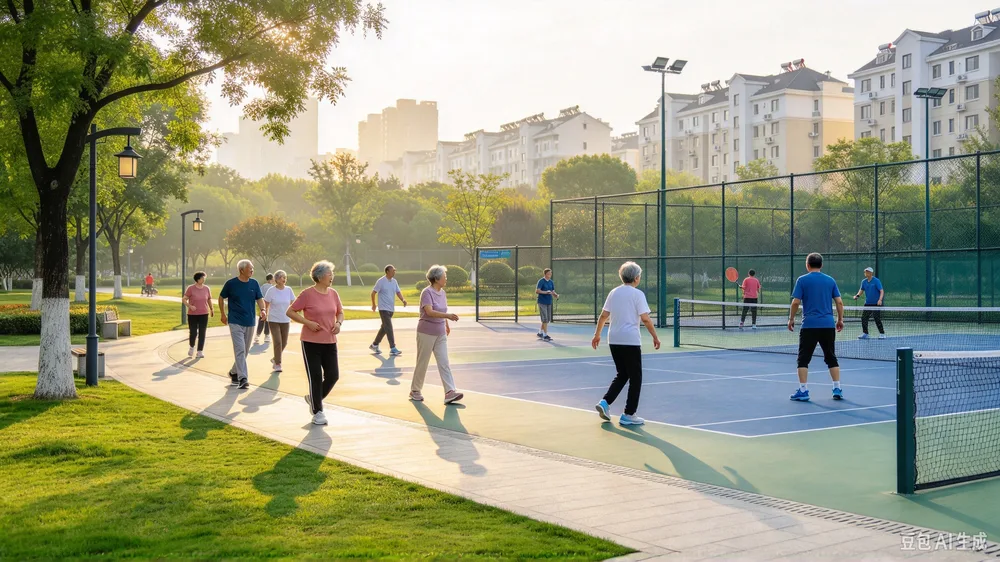
Plazas, parks, walking routes, public courts, pools, toilets, benches, shade, lighting and accessible transit are health infrastructure. A public space becomes active-aging infrastructure only when older adults can reach it, use it safely, rest in it, understand it and return to it regularly.
A city that installs outdoor gym equipment without shade, seating, toilets, wayfinding, program leadership or accessible routes has built equipment without a participation system. Effective design includes continuous walking surfaces, seating at predictable intervals, shade and weather protection, lighting for early-morning and evening use, accessible toilets and drinking water, transit connections, clear signage, low-cost programming, and volunteer coordinators who link outdoor activity to indoor strength and balance services.
That linkage is also a commercial opportunity for operators: municipalities and senior living operators specify facilities, and the equipment and layout decisions flow through procurement. Our commercial setup brand rankings and facility planning tools cover that side of the market.
12. What the next phase rewards
These six countries do not share one ideal exercise for older adults. China organizes movement through recurring social ties and leader-based communities. South Korea combines public supply with low-cost social competition and is now dealing with its own land and access disputes. The United States has built a multigenerational pickleball economy that requires better capability segmentation and safety support. Japan uses routine and low-complexity activity to normalize participation. Germany combines outdoor mobility, clubs, routes and capability-extending equipment. England connects walking, local leadership, public health and everyday movement.
Their shared lesson is structural:
Older adults do not stay active because a sport is popular. They stay active because a system makes participation affordable, understandable, nearby, social and compatible with changing physical capacity.
The next phase of the active-aging economy will not be defined by more generic “65+” programs. It will be defined by organizations that recognize functional diversity, protect trust, build community before transaction, and connect enjoyable activity to the strength, balance and mobility people need to stay independent.
The future of active aging is not an age bracket. It is a participation pathway.
Frequently Asked Questions
What exercise is best for older adults?
There is no single best exercise, which is the central finding of the WHO and CDC guidance: adults 65 and older need a combination of aerobic activity, muscle strengthening, and balance or functional activity, so a walking routine alone does not cover strength or reactive balance. The more useful question is which activity a given person can reach, afford, understand and repeat. Activity that people actually continue consistently outperforms a theoretically superior program they abandon.
How many older adults exercise regularly in Japan and South Korea?
Japan’s Sasakawa Sports Foundation reported that 72.9% of people aged 18 and older in Japan participated in sport or physical activity at least once in 2022 and 58.5% at least once a week (survey of about 3,000 adults). South Korea’s Ministry of Culture, Sports and Tourism reported in its 2025 survey of about 9,000 people aged 10 and older that 62.9% exercised at least weekly for 30 minutes or more, falling to 59.5% among adults aged 70 and over, with walking the most common activity at 40.5%.
Why is pickleball popular with older adults, and is it safe?
A smaller court, doubles formats, simple equipment and learnable rules reduce barriers relative to tennis. It is not universally suitable: players must accelerate, decelerate, turn and side-step. A US study of pickleball injuries treated in emergency departments (NEISS 2013-2022, 1,110 cases) found adults aged 65-80 accounted for 61.1% of injuries, with falls the leading mechanism in that band and fractures the most frequent diagnosis. Capability screening and ability-matched partners matter more than the label ‘senior-friendly’.
What is park golf?
Park golf is a simplified, low-cost golf format played on compact public courses. South Korea is the most developed example: a May 2026 National Assembly Research Service report counted 254 courses in 2020 rising to 552 in 2025, association membership growing from about 45,000 to about 229,000, and total users including non-members estimated above 600,000. Course sizes vary widely from 9 to 36 holes, and the same report notes supply-side disputes over land use and permits.
How should gyms design programs for older members?
Use a capability pathway rather than an age label: a low-intimidation entry point, social retention mechanisms (fixed cohorts, familiar instructors), functional capacity building (strength, balance, mobility, lower-body power), and escalation or referral routes for participants who need clinical review. Measure attendance consistency, 4-week and 12-week retention, functional progress and injury incidents rather than membership sales alone.
Is walking enough for older adults’ fitness?
Walking is the most common entry activity because it is cheap, accessible and compatible with daily life, but it does not reliably deliver progressive resistance, reactive balance practice or fall-recovery capacity. Someone can walk daily and still struggle with chair rises, stairs or side-stepping. The practical answer is not to replace walking but to layer short strength and balance modules into it - sit-to-stands, calf raises and supported balance work.
FitnessNav view: every statistic in this report is attributed to its source — the WHO and CDC guidelines, the Sasakawa Sports Foundation, South Korea’s Ministry of Culture, Sports and Tourism, the National Assembly Research Service, SFIA, NHS digital datasets and peer-reviewed studies. Where a study supports only part of a claim, we say so; our methodology explains how we separate published research from operator marketing.
Dr. Elena Rodriguez is Chief Performance Scientist at FitnessNav, holding a PhD in kinesiology. She leads our nutrition integrity audits and biometric accuracy testing, and her work focuses on the gap between what equipment is designed to deliver and what older adults actually need. Nothing in this report constitutes individual medical or rehabilitation advice.