
Mikolo Fitness
"Budget home gym brand focused on cable machines and functional training equipment."
Mikolo Fitness Review 2026: Strategic Evaluation
VERDICT
Mikolo Fitness is a Challenger in the equipment sector. Their current performance index remains Stable.
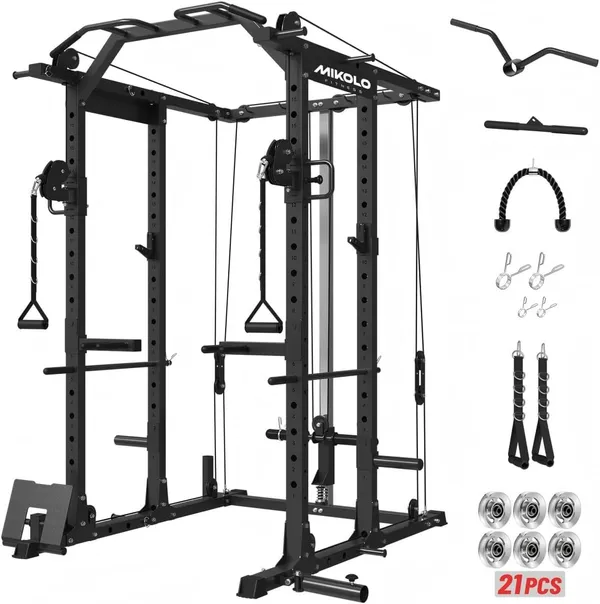
Top Mikolo Fitness Picks (1)
Overall Score
Market Standing
Challenger
Price Positioning
Asset Performance Matrix
Verdict
Mikolo Fitness delivers the lowest entry price for home gym equipment but trades off durability and support, making it a marginal choice for commercial applications.
Market Position
Budget-friendly online-direct fitness brand for home and micro-gym segments.
Unique Value Proposition
Mikolo’s proprietary cable pulley system uses polymer-coated steel cables and sealed bearings, reducing friction and noise compared to traditional nylon cables while keeping per-unit cost under $150, enabling a sub-$1,000 functional trainer package.
Strategic Strengths
- Aggressive pricing reduces upfront CAPEX by 50-70% compared to commercial brands, enabling rapid deployment for budget-limited buyers.
- Modular designs allow easy assembly and reconfiguration, minimizing installation costs and downtime.
- Compact footprint for space-constrained facilities, improving floor utilization efficiency.
Operational Risks & Limitations
- Welds and frame coatings show early wear under frequent use, degrading structural integrity and increasing maintenance costs within 12-18 months in light commercial settings.
- Limited spare parts availability and non-standard components extend downtime during repairs, with typical lead times of 3-6 weeks from overseas suppliers.
- Warranty terms are below industry average (1 year frame/90 days parts vs. 10+ years for commercial brands), undermining long-term TCO predictability.
Risk Assessment
Reliance on just-in-time overseas inventory and absence of regional service centers create supply chain vulnerability, with parts scarcity escalating maintenance costs by 200%+ in year 2.
Buyer Recommendation
Select Mikolo only for defined-use scenarios: home gyms under 5 users or boutique studios with low daily throughput (<10 cycles/machine). For any high-uptime requirement, allocate budget to commercial-grade brands like Life Fitness or Technogym.
Best For
- Home gyms targeting muscle-building with limited floor space
- Private personal training studios with 1-2 clients per machine per day
- Apartment or office gyms requiring light-impact strength equipment
Ideal Buyer Profile
- Cost-conscious home fitness enthusiasts prioritizing immediate cash outlay over long-term durability
- Small fitness entrepreneurs opening their first studio with minimal capital
- Property developers outfitting low-usage wellness rooms in residential buildings
Not Recommended For
- Commercial gyms with peak-hour occupancy exceeding 50 users/day per machine, due to frame fatigue and warranty limitations
- Corporate wellness centers needing 3+ years of reliable uptime without frequent replacement cycles
- High-intensity training facilities (CrossFit, bootcamps) where impact loads exceed Mikolo’s 250-lb weight stack ratings
Competitive Positioning
Mikolo sits in the ultra-budget tier below NordicTrack and Bowflex in the home market, but lacks the UL certification, ASTM compliance, and structural engineering rigor required to compete with entry-level commercial brands like Precor or Cybex.
Frequently Asked Questions
Is Mikolo Fitness equipment durable enough for a garage gym?
Yes, for a single-user garage gym with moderate use (3-5 sessions per week), Mikolo’s frames will function adequately for 2-3 years before showing wear. The cable system holds up well, but the pulleys may develop noise after 12 months. Expect to invest $100-$200 annually in lubrication and minor adjustments.
How does Mikolo compare to Bowflex for commercial use?
Bowflex offers stronger warranty (10-year frame) and better parts support through Nautilus, but both brands target home rather than commercial. For light commercial, Bowflex’s Revolution line holds up longer; Mikolo’s lower initial price is offset by higher maintenance frequency and downtime.
What is the total cost of ownership for Mikolo over 5 years?
On a $1,500 functional trainer, plan for $400 in parts/maintenance over 5 years for home use. For light commercial (daily use by 5 users), TCO balloons to $1,200 due to cable replacements and pulley repairs, making it cost-competitive only against premium home brands like Life Fitness’s home line.
Can Mikolo equipment be used in a physical therapy clinic?
Only for low-rep protocols with patient weight <200 lbs. The absence of fine incremental weight adjustments (2.5-lb increments) and limited range of motion settings make it suboptimal for rehab. Commercial brands like Technogym offer better adjustability and safety certifications for clinical use.
✓ Strategic Strengths
- Audit criteria met.
! Operational Risks
- No critical risks flagged in current cycle.
Frequently Asked Questions
What is Mikolo Fitness?
Budget home gym brand focused on cable machines and functional training equipment.
How does FitnessNav rate Mikolo Fitness?
Mikolo Fitness scores 7.0/10 overall in our v3.0 model, which places it as a Challenger among the fitness equipment brands we track. Its strongest dimension is manufacturing quality (7.0/10) and its weakest is manufacturing quality (7.0/10). Overall score = manufacturing quality 25% + R&D innovation 20% + interface UX 20% + capital efficiency 15% + support 10% + tech readiness 10%.
Who is Mikolo Fitness best suited for?
Commercial gyms, multi-site operators and studio buyers comparing equipment suppliers. In this segment the decision usually turns on build quality, service life and capital efficiency before list price.
How does Mikolo Fitness compare with alternatives?
Our published rankings place Mikolo Fitness in 7 best lists, including Best Affordable Gym Equipment Brands and Best Cable Machine Brands. Same-sector peers are listed below, each scored on the same six dimensions.
How much does Mikolo Fitness cost?
We do not publish price tiers we cannot verify. Verified equipment and software options for Mikolo Fitness are listed on this page with live retailer pricing. We may earn an affiliate commission when you buy through those links, and that never influences our scores.
Network Nodes
Related in equipment Sector
Related Equipment Brands
Frequently ranked alongside Mikolo Fitness